Wednesday, March 9, 2016

Grieving the Death of Systemic White Supremacy in 5 Stages

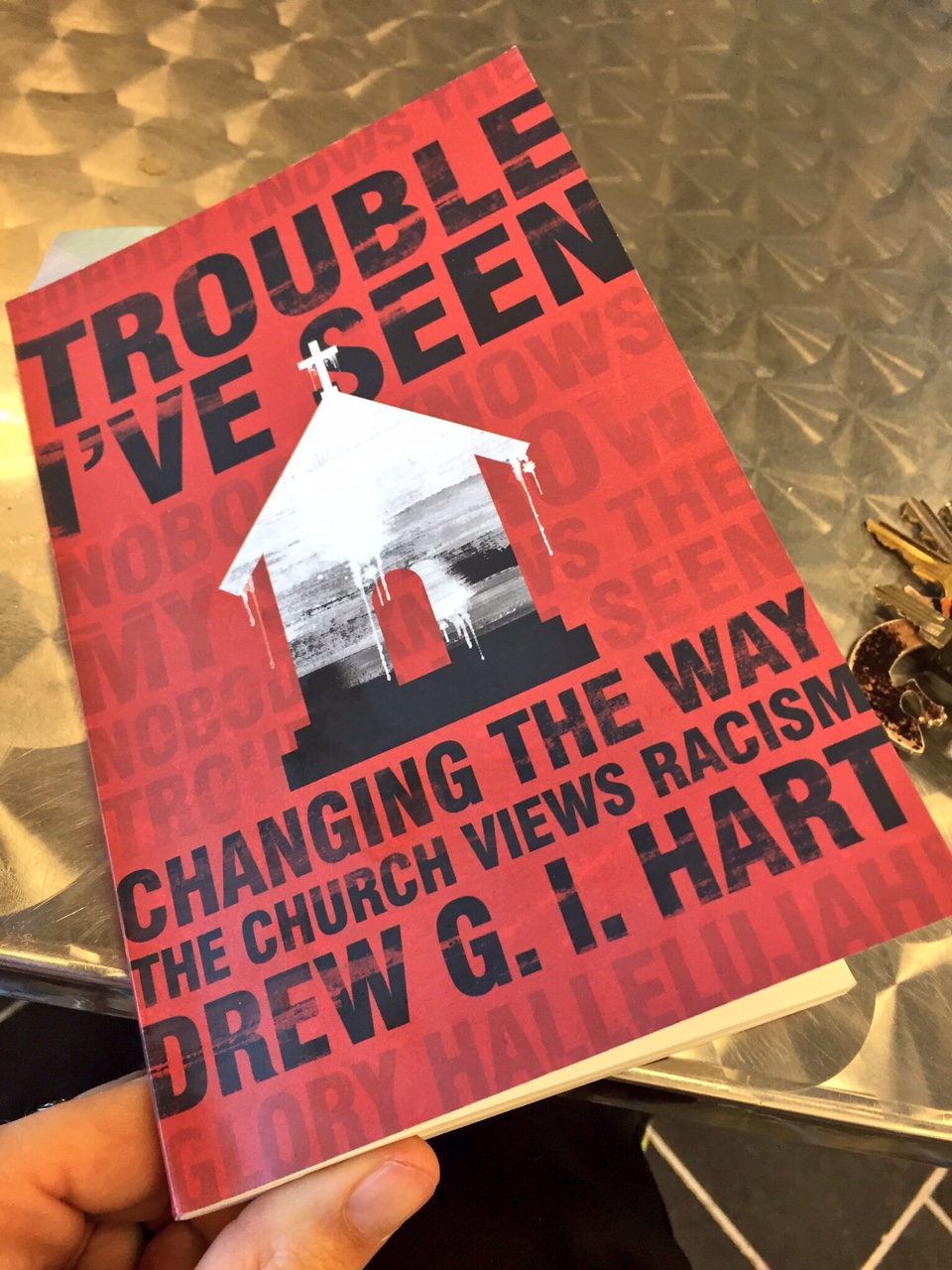
Buy this book right now or sooner, click here
"It is this very act - the careful and patient observation of systemic racial components of our society - that the majority of white America has refused to engage in.  Choosing to trust their own intuitions and personal, subjective assessments - which are socialized in dominant culture - many white Americans focus on an individual [race] card rather than attempt to make sense of how that card fits into the larger deck." - Drew G.I. Hart, from Trouble I've Seen, Changing the Way the Church Views Racism

Last night, as part of our regular DOOR Hollywood activity of breaking bread and talking about systemic racism and classism, our longtime friend, pastor, and educator Manny Flores spoke about the danger of not giving people ample time to process, reminding me how I've had 20+ years to wake up to the powers and principality of white supremacy in our country, what I've been calling Whiteousness.  Again, not against people, but certainly against mindsets of violence and indifference that benefit, mostly, me.

Manny preaching to a team from Kalamazoo at Dulan's
My wife, Darcie, commented this morning about how important that is, that people are given time to process, reconsider, and move towards repentance and new hope.  But: what happens more often is this: Donald Sterling or Paula Deen or Donald Trump or some other white person says something outright hateful, and we say, "that, that is racism."  The trouble is, that focuses on an individual incident and covers up the system that we all live in, from which only some truly benefit.  But: white people who aren't prone to overtly hateful statements feel trapped, afraid to actually say anything for fear that if they mess up, they will be branded with a big scarlet R on their forehead for the rest of life.  It's what Toni White and Marvin Wadlow Jr. have been saying all along, too, that we have to allow for a time of process, and that the end goal should never be for "pink people" to hate themselves, but for a new place of awareness, compassion, love, and listening.  A place of God-centered, right relationships.  Justice.

Darcie said that we need to imagine Dismantling Whiteousness along the typical stages of grieving.  Yes, yes we do.  So, Anglo sisters and brothers, let's imagine this process:

What has died?  The absolute certainty that white lives matter more than others.  The American Dream looking like Leave it to Beaver or Friends or The Brady Bunch or..  It's the death of the 1970s image of Jesus looking like a band member of Lynyrd Skynyrd.  The idea that whiteness, or white ways of life, is "normal" American life.  The good old days, which weren't good for everyone anyway.   Let it die.  It's been a distracting mistruth for quite some time.   Listen again to Jesus about dying to oneself, from the Message paraphrase from Luke 9:  Don't run from suffering; embrace it.  Follow me and I'll show you how.  Self-help is no help at all.  Self-sacrifice is the way, my way, to finding yourself, your true self.  What good would it do to get everything you want and lose you, the real you?

Grieving the Death of Systemic White Supremacy

Phase 1: Denial and White Fragility
In this phase, a white person denies that racism exists.  We may say, but look, we elected a black President.  We may say Justice is Blind.  We may say, I don't see color, I'm colorblind.   We may say, black people have all the same rights as everyone else now.  We may say that Asians are the perfect example of how minorities should assimilate into US Culture.  We don't want to talk about this, because we don't see the problem, but I'm guessing most of us internally feel the truth that the problem exists.   So it's really about White Fragility, that it's too hard to face, to talk about, and we are scared about what it will mean if we actually acknowledge it.  Much like losing a loved one, we are afraid to face the new reality of life without them, so everyone knows that they shouldn't engage us in direct conversation yet.

Phase 2: Anger and Asserting Whiteousness
In this phase, we get angry when people want to talk about the death/dying.  Stop playing the race card, we might shout.  This is where we imagine the myth of "reverse racism," that the true victims in the racialized society are white people.  Look at affirmative action, look at intentional measure towards diversifying companies.  This is ruining me, so stop complaining, we might yell.  We might say, "but I never owned slaves, I never used the N-word!"  This is where we say, but I'm a good white person, why is this happening to me?  White people aren't the problem, it's all the people who want to keep talking about race, they are the ones who are fueling the fires of hatred.  If they would just shut up....

Phase 3: Bargaining and "But look, I have a good Latino friend...."
In this phase, we pick up the thread of "but I'm a good white person," I have a black friend, a Latino classmate who I like.  This is where we tokenize and try to rationalize our current, detached lives as being part of the solution instead of part of the problem.  We fail to realize that the friends we make that look different than us are often people we feel we can agree with.  Look, this black person didn't vote for Obama, because...or my friend is a Latino criminal prosecutor and she is all for tougher sentences on petty drug crimes too.  We believe the "nice black neighbor" we have is an exception to the rule, and if only all the others could act like him.  In the phase, we sometimes step into believing we have the answers to save everyone, and the White Savior Complex sets in, which quickly moves us into:

Phase 4: Depression and White Guilt
This is the hardest phase for liberal, progressive, and moderate white people.  This is where most of us are stuck.  We see the problems, and we are overwhelmed with the crushing realities of the system, both because we want to fix it, but we are trying to fix it from the perspective of Whiteousness, that white people are the best solutions to every social ill, though we strongly sense that we are also the root of every social ill.  We have difficulty recognizing how we are hanging onto the comfort of being white, hanging onto the inherent privileges that it brings.  We succumb to a sort of numb paralysis, either too embarrassed or too ashamed, and it keeps us from engaging any further.  Sometimes, we circle back to a new form of denial, and decide to focus on another issue within society.  This one is just too much for us and I want to go to the spa in the nice part of town.  I should be allowed to just relax, right?  And the cycle can begin again, if we find ourselves in a new context where race is discussed, because a coworker is angry about, say, Ferguson or people who are down on Donald Trump.  But if we don't, we might just go back into our white privilege and close our eyes and pretend we've figured it all out (but it's a new form of denial).

Phase 5: Acceptance and Dismantling White Supremacy
This is the phase of awakening.  We see a path forward, but it definitely must be without the past life. Someone has died and we have decided to move on for the health of all of us still living.  We can see that some of that life was okay, but other parts were deeply problematic.  We no longer wish for the good ole' days, as we see the inherent fallacy of that perspective.  Where we were scared of what's to come, we have started to sense direction.  And it is not about us, alone, because we have listened and listened and listened and are eager to keep listening.  We have stopped doubting the narratives of minorities and started to trust that, not only are they accurate and critical stories, but they are helpful in healing, both in our own healing, and in a collective healing.  It's like the moment in The Matrix where we can finally see how stacked the deck, or the green programming code cascading all around us, has been in our favor.  We can also recognize how it has enslaved us as well.  We see Jesus' words about the last shall be first and the first shall be last with new eyes, and we understand why he spent so much time with folks whom society was purposefully marginalizing.    We step in, scared but open, trusting and questioning and listening, even the tough questions and the hard-to-hear answers, even if we mess up and are called harsh names along the way.  We are finally open to receiving the help and critique and wisdom that has been here all along, waiting for us to come out of our hole.

Let's listen to our black, brown, Asian, and Native brothers and sisters.  Let's hear about the "other Americas" experienced by refugees, prisoners, transgendered siblings, Muslims, trafficked young people, undocumented neighbors, those living on handouts on the sidewalks.  We have much to learn, and there is abundant life ahead if we learn to let go.  Jesus staked his entire life on it.

-by Darcie Yobp &  @MatthewJSchmitt

For the last word today, take a listen to this awesome brother, jason chu:


Tuesday, March 8, 2016

I'm Not Your Mulatto

Here's a thought: people of color are not our playthings or property.  Sure, we're way past that.  Are we?

About one month ago, my friend and colleague Suzanne and I were getting coffee at La Monarca at the corner of Gower and Sunset in Hollywood.  We hadn't seen each other for quite some time, and as our jobs are quite similar, we had much to chat on (and commiserate!)
Photo: Zazzle.com

An older white woman asks us to watch her things while she goes to the bathroom.  We agreed, but she never went to the bathroom, I think that was just a way to interrupt.  The white woman, we'll call her Edith, says to Suzanne: "you have such an interesting look, what are you?"

Suzanne, smiles, and asks her what she means.  Edith asked if she was South American?

Suzanne tells her, actually, she is mixed race, with African-American and Spanish....but before she can finish explaining that, Edith interrupts, cheerfully, "oh, you're Mulatto."

Both Suzanne and I were stunned to hear that word, and I think it was Suzanne, but she remembers it was me, either way, this was said: "well, we really don't use that anymore..."  But Edith launched into her history lesson at us.  I say at us because it clearly wasn't for us.  But she was kindly, she was nice, she wasn't trying to be rude, she was trying to make conversation and connect.   She spoke intimately about the tones of color on Suzanne's face, her eyebrows, etc.  And she looks at me and asks, "where do your ancestors come from?"

I thought it only fair that I be asked, though I do remember the clear difference that I was asked a question with more respect than what are you, so I said, German, French, and I couldn't remember Dutch, but for some reason I was thinking it was Finnish, so I said that.  (Sidebar: us modern white people sometimes have to ask our parents about ancestry because it's just not usually necessary that we know anything other than white.)

Edith lit up.  "Oh, do you know that Finns are the purest race?"  Which was my cue to interrupt her to say that Suzanne and I only had a little bit of time left to catch up, so Edith nodded and went on her way.

Edith seemed to think she was making friends with us, oblivious to her condescending and insulting demeanor.  I was so moved by Suzanne's grace and patience through the entire ordeal, and was on guard for the moment I thought Edith might ask if she could touch Suzanne's hair.
Photo from onpoint.wbur.org

Before it sounds like I'm arguing about a generational gap, let's move to downtown Atlanta, Georgia, where I was staying at the Airport Hilton as part of a traveling gig with Deana Carter's band just last summer.  Summer is high-time for family reunions, especially in the African-American community.  In fact, this particular weekend, there were four separate families gathered at this one hotel.  Each of the families, I came to learn through conversations hanging out at the bar and the coffee shops, had about 150 members who had traveled in for the events.

At the front desk when I checked in, a woman who was probably 7 or 8 months pregnant, was standing nearby.  A young white woman, probably my age, noticed her, asked her when she was due.  They had a nice exchange of small talk, and then the white woman commented on how fantastic the pregnant woman's Afro looked, and, you guessed it, asked if she could feel it.  The pregnant woman said "no", and she also added, "and just cause I'm so tired of being asked this, you also can't feel my belly."

Here was a moment of awakening.  The white woman recognized connection, as a mother herself, being reminded of how annoyed she was that people thought they could just feel her belly in check-out lines at the grocery store.  And, further, she self-connected it to how inappropriate it was that she tried to feel an Afro.  After I checked in, I walked away and the two of them were laughing together, the white woman having long since apologized.

Other people, no matter how kind and connection-seeking we think we are attempting to be, are never our property or plaything.  And if we cross that line, it is on us to apologize.

Later that morning, one couple, who I thought were married but were actually a brother and a sister, invited me to have breakfast with them.  They explained their particular family history to me.  Their matriarch, who's name was emblazoned on the front of their bright purple t-shirts similar to the one in the photograph above, was a slave.  She had 12 children, and the brother liked to point out, "you know, like the 12 tribes of Israel?"

Those 12 families have managed to stay in contact for over 150 years, committed to coming together ever 2-3 years in a big way.  They appoint regional coordinators whose job it is to keep tabs on all the family members in Chicago, Detroit, New Orleans, Atlanta.  They fundraise at churches and through bake sales to make sure every family member who wants to attend, can, regardless of current employment or income.  And this, I came to learn, was almost identical to the other family gatherings going on around me that weekend.

It makes sense, when you remember that an African-American's ancestry has a clear start date.  Well, first a very violent end date, where centuries of bloodlines were severed and thrown into a helter-skelter during the slave trade and the Middle Passage.  My friend Marvin always says, for African-Americans, all roads lead to the South (of the US).  Now, these new sibling friends of mine had fun pointing out that with 150 family members, oh yes, there can be drama, help me Jesus.  But keeping their story alive and keeping the relationships well oiled and maintained, that is something they all believe in.  We white folks must learn to respect and honor this, not just try to be cool by imagining how "with it" we are by thinking we're cool with Afros, we are educated because we have studied racial history and know a thing or two.  This goes for all y'all as well as me.

So, Edith, instead of telling Suzanne about her people's history, why not asking her about her family history?  Could it be that Suzanne has something to teach and offer you?  Here's something she taught me while we talked about this experience, Las Castas, the Spanish Racial Classifications that had all kinds of connotations and degrees of status.  And on the day you interrupted our conversation, Suzanne taught me a bit about patience in the face of indignity.

Peace and blessings,
@MatthewJSchmitt


Saturday, March 5, 2016

One Month of #DismantlingWhiteousness

Thank you.  It's been nearly one month, and I know this blog is striking an important note, so I will continue.  I hope it can soon become more than just my voice, or my ideas.  Obviously, the first month, like a first album for a singer-songwriter, there's all of these posts and thoughts that have been fermenting for quite some time, kind of exploding.  I appreciate your grace with this and look forward to more rich, robust, and meaningful dialogue as a first step towards forgiveness, repentance, and maybe even a taste of reconciliation.

Please send articles, ideas, conversations, your own blogposts to me on Twitter through @matthewjschmitt!

If you're new to this blogsite, here's the thing: this is not anti-white people.  It's anti-white supremacy.  Which, doesn't only look like the KKK.  White-Supremacy is the mindset, the power, the principality that white is "normal," white is "smartest," white is "best," white is "kindest," white should be in charge.  It's against the notion that Jesus was a white man who looks like one of the Allman Brothers.   It's against the notion that white Christians are God's new chosen, in the sense that we have a life insurance policy to get into heaven's big retirement gates first.  I will speak against this arrogance and in the face of this power, reflecting on the many ways God has sent prophets of color in my life these past 20-25 years.  And friends.  Deep, deep, mentoring, loving, challenging, and very wise friends.

Here's a table of contents of sorts:

Why "Dismantling Whiteousness?" - Explaining the reasoning in launching this.  And remembering Levi, the man in prison who converted me to Christianity.

Prison Snow: My First taste of Non-White Non-Privilege - a poem about growing up a few miles away from a frozen hell.

Voices from the Movement of Teach For America - TFA is expanding, rightfully, into teaming up with modern Civil Rights movements.

Walking from Dulan's Soul Food to the Asian American Drug Abuse Program

Who Said Women Can't Preach? (It wasn't Paul....) - the amazing Dei, Toni, and Diane preached the gospel from a non-WASP perspective.

On Being Called the White Devil - honoring the hatred hurled at me, and respecting why it cannot stop me from sharing these stories

On the Black Boy Arresting the Cops in Beyonce's Formation Video - the song is not anti-cop, it's pro-humanity.

Confessing My Whiteousness - inspired by Kendrick Lamar calling himself a hypocrite, I too, must confess

Why Do I Need to Talk to White People? - kids of color always have to talk to white people, but white kids don't have to talk to people of color if they don't feel like it....

The Tragedy of Whiteousness for White People - I think my favorite post to date.

How Tori Amos Primed me for Dismantling Whiteousness, #NativeLivesMatter - she taught me to play the piano, and she taught me to ask tough questions of people in power.

America, by André Henry - an incredible classmate from Fuller Seminary is also a prophetic singer-songwriter

Wake Up! - the text of a sermon born in the Garden of Gethsemane and moving into modern racial reconciliation work

Erykah Badu and D'Angelo in 2000 - formational albums for me

#ZipCodeMatters, Sadly - on the deplorable practice of protecting and serving wealthy people first and foremost

Entitlement, Revisited - though poor people of color get blamed for our country's ills, I believe it's wealthy white folks who have more to repent, here

To the Man Who's Name is Not Lamont - how white folks, like myself, treat people of color with disrespect on a daily basis in small and large ways

Peace all, more to come - M

Friday, March 4, 2016

To the man who's name is not Lamont

Dear Man at the gym who's name is not Lamont:

I'm sorry I forgot your name. I'm sorry I remembered you by who you are not. Thanks for teasing me and reminding me what your actual name is, though, I'm not typing that here since I didn't actually get your permission.

And thanks for coming up and talking with me again, even as I was typing this apology!

Thanks for asking why you were able to remember my name, but I just kept calling you a traditional black name. I said because I'm a jerk. You laughed and said, yeah.

But the funny thing is, and it's really not funny, is that so many of my Anglo brothers and sisters do forget the names of people we don't see as being enough like us. The worst story was my friend and blogging inspiration, Austin Brown, who was once a coworker with me in DOOR. She was hosting a church group of white people in inner-city Chicago, in a low income black neighborhood. From her name, they assumed she was a white male, like me. They wouldn't get out of the car when she came to greet them at their window because she frightened them. And once the confusion was cleared up, a white male leader continued to "not remember" her name. Called her Ashley, Andrea, anything but her actual name. Even after she and her staff fed them and showed them generous hospitality.

They wound up leaving the program 5 days earlier than expected. Some might have seen them as fleeing, others may have remembered Austin kicking them out. Either way: they left because they were hardened by their Whiteousness.

So: I am sorry and thanks for cutting me some slack. And thanks for finding some way to make fun of me. I deserve it.  Hope you can forgive me.

From now on, I got ya D.

@matthewjschmitt


- Posted using BlogPress from my iPhone

Thursday, March 3, 2016

Entitlement, Revisited

If one of your brothers becomes indigent and cannot support himself, help him, the same as you would a foreigner or a guest so that he can continue to live in your neighborhood. Don’t gouge him with interest charges; out of reverence for your God help your brother to continue to live with you in the neighborhood. Don’t take advantage of his plight by running up big interest charges on his loans, and don’t give him food for profit. - Leviticus 25:35-37, The Message

Give me your tired, your poor, your huddled masses yearning to breathe free.  The wretched refuse of your teeming shore.  Send these, the homeless, tempest-tost to me, I lift my lamp beside the golden door. - Emma Lazarus, engraved on our Statue of Liberty.

Last Sunday, here in Hollywood we did what Hollywood does best.  Celebrate itself!  No, I'm not going to write about #OscarsSoWhite, (at least not on this post), but I do want to draw attention to a pretty universal fact.  Whenever anyone wins an Oscar, we expect a speech.  And usually, the winner doesn't have enough time to finish it before the band plays on, or, off as the case would be here.  Sometimes, there is a political or personal platform that gets spotlighted, but most often, the reason they run out of time is because there are just too many people to thank.  From Halle Berry to Brie Larson, Denzel Washington to Leonardo DiCaprio: if they had enough time, they probably could each think of at least 1,000 people who have gotten them to their moment of glory.

And, it seems, we as a society accept this without much thought.  We know that nobody succeeds without a little help from their friends.  Or, tons of help from their friends (or movie studios and agents who also gain mightily when their actors succeed.)  Why, then, do we still seem to subscribe to the "bootstrap myth?"  If you just work hard enough, you will succeed..... (blogger Julian Abagond has a succinct and powerful post on the inherent racial discrimination at play with this persnickety Americanism.)

Here's my take on it: if someone is successful, we like them.  They inspire us.  They give us an image of who we'd like to be ourselves.  But when someone fails, a darker place inside gets activated.  A fearful place we don't like to have much contact with.  Could that be us?

And it often goes further in a very destructive way.

When we see someone living on the street, who amongst us with the blessing of stable housing hasn't, at least once, thought to themselves or even said out loud, "go get a job you lazy bum!?"  My dear friend Toni, who has lived both a six-figure lifestyle and the one-duffel-bag-on-your-shoulder-riding-bus-after-bus-just-to-sleep life, often recounts a story of chucking a large bill at a man outside a sushi restaurant, yelling at him to get his lazy ass up.  She tells that story often so that she never forgets how arrogant the haves can be towards the have-nots.   How would you manage getting a job on 1-2 hours of sleep a night, no clean clothes, no deodorant, no place to clean up?  How do you think that job interview would go?

When people are successful, we can handle the idea that they've had a great deal of help.  Remember, Hillary Swank started her career in Hollywood living homelessly out of a car.   But when people are down and out, we tend to blame it all on their choices, their laziness, their issues.  Could it be that they have just not yet found the right combination of friends to help them?  Could it be they have mental health issues that collide with successfully making friends?   Could we, especially those of us who follow Jesus, ask a different question than: how did they mess up their lives so badly?  What about: how could we surround them with love and work on creating a stronger network of ongoing support?

So what does this have to do with the entitlement debates?  In my opinion, everything.  Let's be honest, who is the poster child for "welfare?"  Is it me?  Or do our imaginations conjure an image like the woman pictured here.  This is not by accident, mind you.  Images like this flooded our media during the 1980's Reagan-Era War on Drugs, which, to be fair was coined by Nixon, and involved Bush the Father as well as Clinton the man.  This was the image of the crack momma, never mind that cocaine use among wealthy white folks in suburbs was far higher than our urban dark-skinned brothers and sisters.  (More on this, read Michelle Alexander's entire book, The New Jim Crow.)

With politicians constantly criticizing people who are "fleecing our health care system, making us pay for their laziness, etc," we have been trained, through repeated exposure, to imagine the image of this woman.  Now, I have no idea who she is, and what happened to her, but it looks like someone came to take a photo without her permission, and she looks pissed off.  Now her image is in stock online photos when you look up War on Drugs, Homelessness, Welfare.  Wouldn't you be angry too?  I pray that, wherever she is, someone is treating her more kindly than this photographer.  There's blood on my hands here too, as I'm using the photo....but I hope to be doing it to prove the next point, and I hope that somehow helps.  Of course, you can decide.
For more, click here

Barbara Ehrenreich, author of Nickel and Dimed, an exposé of the fallacy of minimum wage actually being a living wage, also authored a piece in Time magazine a while back highlighting that in 2001, 61% of the population receiving cash-assistance from welfare is white, while only 33% are black.  In 2013, that number had not changed much.  The chart on the left details who receives food stamps in this country.

The real issue with social security and welfare may be that it was designed during a time when Americans' life expectancies were much shorter.  The coffers weren't designed to support people for 30+ years after retirement.  But, instead of talking enough about that, we blame immigrants, we blame poor folks who are stuck in a hole that would literally take super-human strength to climb out of alone.  Not only are they to blame for their own situations, we blame them for hurting the whole country.  (See Make America Great Again.) But God did not design us to be as independent at the American Dream claims we can or ought to be.  God created us as interdependent creatures, and intended safeguards through the practice of Sabbath Economics, referenced in the Leviticus passage at the start of this post.

Just yesterday at the Sherman Oaks mall, I got to witness, what I believe to be, the heart of the entitlement problem.  The laptop I type this on was performing slowly, so I made a Genius Bar appointment at the Apple Store.  While I was there, not one, but two people impatiently freaked out, after waiting only about 5 minutes, and cursed at the Apple employees.  Another woman was saying to the man helping her, "so, what you're saying is that I could buy this now, then return it two weeks and get the discount, buy it again, return it again another two weeks later, until it's practically free?"  He replied, "I didn't say that."  Her, "Ah, but you didn't not say that."

I went to the food court and watched a woman open not one, not two, but four bottles of Kombucha Tea from the open topped refrigerator.  Each bottle fizzed uncontrollably and she just kept placing them on the counter, making a terrible mess.  She kept accusing the employees of shaking the bottles too much and wanted her money back, plus free lunch.  I had to interject, as my wife actually brews Kombucha at home, (you know, the conscientious resourceful hipsters that we are), so I know that it probably has nothing to do with shaking the bottles, more to do with how long they've sat there fermenting.  No matter, the woman's "righteous anger" was just as messy as the sticky fizz the employees had to clean up.  Thankfully, they did not give her that free lunch.  Can you picture how she walked away?

Then there's the parking lot of Whole Foods.  My Lord, that's a dangerous place, at the very least, to your ears.  The honking and honking at people, like myself, who are taking too long putting their children in carseats.

And don't forget the guy who got nabbed making a call on his cell phone by the bike cop hiding in the bushes.  That guy dropped his phone under his middle console and happened to also have his wallet in his lap.  So when the cop pulled up, he claimed it was just his wallet he was holding and the cop let him go.

I'm guessing, most likely, I don't actually have to type the next sentence, but I'm going to anyway.  All of the characters in the last four paragraphs were white, and many of them were in the Range Rover class of automobiles.  Oh, and the guy in the last story with the cop in his Honda CR-V?  Yes, that was me, though it was a few years ago, not yesterday.

I have family members who work in the medical fields who have story upon story of suburban women in their forties and fifties, usually white, who come into offices and ERs in disguise, demanding that their painkiller prescriptions be refilled.  Security is often involved in the scenes that fizz all over, disrupting everyone.

Middle and upper class white brothers and sisters?  Are we the actual problem with entitlement?  I don't know how to prove it at this stage in my research.  But if we're going to assign so much blame, or elect someone who's willing to blame on "our" behalf,  those single moms on General Relief, those folks who've come out of prison with records that make finding a new job next to impossible without organizations like Homeboy Industries, and those neighbors living homelessly as "the problem" with our country, then we ought to take heed of Jesus' urging to take the plank out of our own eyes first.  We just might see things a bit more clearly.  We might see that, in fact, we were designed to be in this with everyone else, altogether.

@MatthewJSchmitt

Sunday, February 28, 2016

#ZipCodeMatters, Sadly

Shared community at 5846 Gregory, the heart of DOOR Hollywood Dwell 
On the way to church last Sunday, my oldest daughter, 6, asked me, "Daddy, what's the number to call the police?"

"That's 911, and it calls for help, which could be for firefighters, paramedics, or the cops."

"Do they come right away when you call them?"

Well now: I explained to her that when we called 911 when I had a health scare* last year, the paramedics came within a few minutes.  My wife called from the zip code 91403.  And I asked her if she remembered the situation a month later at La Casa de la Comunidad at 5846 Gregory Ave., 90038.  She did, and she remembered how long it took for help to come.

5846 Gregory is located in a predominantly Latino immigrant neighborhood.  It's where the Dwellers of DOOR Hollywood live, and where multiple times a week they engage in communal living with their neighbors, mostly youth.  Sometimes homework is done, sometimes stories are shared, sometimes games are played, sometimes meals are had.  On this particular night, my daughters and I were spending time with everyone, when one of our Dwellers, Sara, comes bounding on the front porch with a mother from the community.

"Help, everyone!  Her daughter is missing, and she's worried she might be in terrible danger.  She called the police but that was about a half-hour ago."

The Dwellers and I moved out to the sidewalk, as a Dwell alumni was there to help watch the children hanging out at the house, my daughters included.

The mother was, obviously, very distressed.  I spoke with her, and learned that, yes, she had indeed called the cops but she did not have much hope they would show.  About an hour earlier, her teenage daughter had left a message that someone was trying to hurt her, and she might just hurt herself instead.

We asked her family to give us a photo, sent it amongst our cell phones, texted everyone we knew in the neighborhood.  We organized in pairs and, with the family and other neighbors, started going up and down the block.

And suddenly, a moment of the Holy Spirit: I remembered something a local Anglo fireman friend had told a group of us at DOOR a few years earlier.  Too often on the dispatch, he was always sickened to hear the unofficial codes that were used to identify situations in lower-income areas.  In particular, he told us of one from the 90038 neighborhood: the "Hysterical Latino Woman."  If a call came through from a Hysterical Latino Woman, he told us, the "protocol" was always delay, to "let her calm down some."  Sometimes that meant they would literally just sit there, not moving at all.  Sometimes, they would drive the long way around.  The very long way around.

So, we tried something, as we felt that we could really use some professional help here.  Molly, another Dweller, herself also Anglo, and I decided to each call 911 from our cell phones.  We reported the same thing using our actual names.

The cops came within 3 minutes.  36 minutes after her mother had called, understandably hysterical, this was her daughter for God's sake!  3 minutes after I called.  2 minutes after Molly called.

Go ahead, tell me it was circumstantial.  Go ahead, tell me that there's no way to prove any systemic or personal racism was occurring.  And you would probably be right: there is no way for me to prove it.  But: when you're standing right next to people in their real pain and walking alongside them in their heart-pounding panic, you know because they know and altogether, the truth is clear.

Our Koreatown family.
My wife and I spent the first few years of our marriage living in a Mexican part of Koreatown.  Cyndy, Kevin, Nicole, Rafael, Kiara and their parents told us that calling 911 was never the first thing that came to their minds.  It was too frustrating and could actually be dangerous.  If someone needed medical attention, you went and knocked on a neighbor's door to borrow their car and you got to the hospital as quick as you could.

Which is what the mother of this story had done.   Thankfully, her daughter was found within the hour, and she was alive and unharmed.  The community and the police collaboratively sought and succeeded.  As I believe it should be.  Why did it require our white voices to spur that into action?

And, unprompted, my daughter asked me on our ride to church this full year later: why didn't the police help sooner?  And, like always with questions of justice, we have committed to telling our kids the truth.

"Even though Jesus is clear, that all lives matter equally to God, there are many people who believe that some people are worth more and some people are worth less."

It's the ugliest truth about humanity I know.  It's the crime of Whiteousness.

Emma and Cecilia
We know many mothers in the 90038 zip code near La Casa and many mothers know us.  I dare you to tell me that Emma's life is less valuable than Darcie's, the mother of my children.  Emma who sells tamales to neighbors to raise her three children and has cooked thousands of meals for DOOR Hollywood Discover groups.   Emma, who immediately after her best friend Cecilia was killed in a horrible car accident at 5:30 one morning on her way to work by a drunk driver on their way home from a club, took on caring for four additional children, especially while Cecilia's husband healed from his broken ribs.  I dare you tell me that Cecilia's life didn't matter enough to merit a response whenever she may have called out for help, while she was raising four amazing children.

Or Yolanda.  Or Lydia.  Or Rosy.  Or Sylvia.  Or Becky.  Or Gladys.  Or Mercedes.  Or....... I dare you.  If you tell me something about tax dollars and property values and response times and safety for the officers, I may hear you, but I won't be listening.    Especially if you are talking from the point of view of someone several steps removed.  Or several zip codes away.

Hold someone else as they shake with fear and anger, listen to them tell you why they don't trust law enforcement or emergency services.  I definitely respect the idea that officers must worry about the safety of themselves and their teams.  But intentional delay?  Logic would have it that the longer you wait to provide help, the more escalated the individual would become.  So don't tell me that "waiting for her to cool down" is about safety.  It's about a stratified value of human life.  It's about racism.  And we must expose it, lament it, confess it, and repent it.  God help us.

@MatthewJSchmitt

Check out another brief take on Zip Code inequality by Marvin Wadlow Jr.  above.


* I had accidentally ingested a dessert made with pot, and it launched a full-on panic attack that felt like dying, all in all a hilarious, White-privilege-laced story for another time.

Cyndy holding our daughter, years ago
Yolanda, holding our youngest, after dropping off donations.

Which child is more valuable?  Ask that from God's point of view, ask that from a politician's point of view.


Erykah Badu and D'Angelo in 2000


Tomorrow is February 29, a bonus day in this Black History Month, even though it's still the shortest month of the year.  (Not to mention that Black History should be so much more embedded in US History...)

I've given quite so much love and gratitude to Tori Amos recently, it might look like I'm a little crazy.  (That might be said, but few have moved me to act and write like her.)  (Oh, and I am crazy, I hope in a good way.)

Of those few, Erykah Badu's Mama's Gun and D'Angelo's Voodoo, both released in the year 2000, were the soundtrack to my life after Y2K didn't shut us all down.  Interestingly, in 1999 Tori Amos put out an album that really did not resonate with me as a whole, so my ears were seeking.

These two albums were like a brother and sister taking turns in my Oldsmobile Alero CD slot.  They got me to and from work, Fannie C. Williams Middle School in New Orleans Upper 9th ward.  They taught me how to hear black people, how to hear from black people, and how to pay attention to life around me.  My students were also making me mix tapes, (my Alero actually had that slot too!) of Juvenile, Destiny's Child, DMX, the 504 Boyz, and their own personal free-styling.

But it's these two that really taught me how to be loved by my new New Orleans' community.


Happy Leap Day.  Take a leap back and check the full albums out if you don't know them before Black History Month is in your rear view mirror.  Stay in touch @matthewjschmitt

And without any further ado,
check out verses of D'Angelo and Badu

From Penitentiary Philosophy (above)
Oh why can't we get along and
Take all the funky tones
And make up a funky song
That be bangin on and on
Make me mad when I see ya sad
With the same look ya momma had
But ya can't win when your will is weak
But ya get out ya seat
Oh why Why Why world
Do you want me to be so mad
So mad yeah - Badu
Bridge!
I remember when I went
With Momma to the Washateria
Remember how I felt the day
I first started my period
Remember there in school one day
I learned I was inferior
Water in my cereal - Badu

Bag Lady (below) 
Let it go, let it go, let it go, let it go
Ooh, ooh
Girl you don't need it
I betcha love can make it better - Badu


From Playa Playa (above)
We came here to rip sXXX
Strip U of your clout
Later 4 all y' all HATERS
We gon' turn this motha' out
If U came to ball u gonna lose it all
We don' t plan 2 stop
Til U bounce off the wall
Til U bouncin off the wall- D'Angelo

From Devil's Pie
Who am I to justify
All the evil in our eye
When I myself feel the high
From all that I despise

Behind the jail or in the grave
I have to lay in this bed I made
If I die before I wake
I Hope the lord dont' hesitate
2 get 2 heaven done been through hell
Tell my peeps all is well
All them fools whose soul's 4 sale
Sitting next to the Jezebel - D'Angelo
If you wanna come on down 2 the front
baby yo it's cool everybody fakin the funk
i'ma put u in school, take a lesson from adolescence 2 man
I got the music and the instruments use em as my weapons at hand
everybody on the floor if u listening 2 me
clap your hands stomp your feet
I just wanna put u down (yeah)
I just want ya all 2 get down (yeah)
everybody come get down 2 the chicken grease (yeah) - D'Angelo


Africa (left)
Africa is my descent
and here I'm far from home
I dwell within a land that's meant
meant for many men not my tone

The blood of god is my defense
let it drop down 2 my seed
showers 2 your innocense
2 protect U for all eternity
and with this wood I beat this drum
and we won't see defeat - D'Angelo


- Posted using BlogPress from my iPhone

Friday, February 26, 2016

Wake Up!

 This is the text of a homily I delivered as part of a Lenten series at Hollywood Presbyterian Church on Wednesday, March 2nd, 2016 at 7pm in Wylie Chapel.  

And you can link to the full series, multiple preachers, here: FPCH LISTEN ONLINE.  


Matthew 26:36-46, The Message: Then Jesus went with them to a garden called Gethsemane and told his disciples, “Stay here while I go over there and pray.” Taking along Peter and the two sons of Zebedee, he plunged into an agonizing sorrow. Then he said, “This sorrow is crushing my life out. Stay here and keep vigil with me.”

Going a little ahead, he fell on his face, praying, “My Father, if there is any way, get me out of this. But please, not what I want. You, what do you want?”

When he came back to his disciples, he found them sound asleep. He said to Peter, “Can’t you stick it out with me a single hour? Stay alert; be in prayer so you don’t wander into temptation without even knowing you’re in danger. There is a part of you that is eager, ready for anything in God. But there’s another part that’s as lazy as an old dog sleeping by the fire.”

He then left them a second time. Again he prayed, “My Father, if there is no other way than this, drinking this cup to the dregs, I’m ready. Do it your way.”

When he came back, he again found them sound asleep. They simply couldn’t keep their eyes open. This time he let them sleep on, and went back a third time to pray, going over the same ground one last time. When he came back the next time, he said, “Are you going to sleep on and make a night of it? My time is up, the Son of Man is about to be handed over to the hands of sinners. Get up! Let’s get going! My betrayer is here.”

A week and a half ago, Pastor Dan Baumgartner opened up about his childhood love for the legendary Batman and Robin of black and white TV.  Full confession, I loved that show too, though I benefitted from syndicated reruns a decade or so later.  The modern network TNT claims that “they know drama,” and if that’s the case, they must have learned it from our original hero, the storytelling Word of God himself.  I mean, check out this cliffhanger:  My betrayer is here!  Spoiler alert: next week’s episode, if we followed this text, would involve some overzealous police brutality, a kiss of death, an actual riot, an ear sliced off and being miraculously put back on, that is if we turned to Luke’s version, or treatment, as we call it in Hollywood.  I can think of few other moments in Scripture where the drama is so heart-poundingly intense, such an intersection of divinity and humanity, with dialogue much like an actual script.  In the universe of Christianity, the Garden of Gethsemane is like a big bang.  This is really good television!
            But: this is real, we hang our faith upon the truth of this drama.  And I think even Reality TV has been touched: Jesus coming down from high and experiencing what it feels like to be human.  CBS’s show Undercover Boss, where a CEO poses as an entry-level employee and gets to know the company from the ground up through serving alongside workers and sharing lunch together in break-rooms, was the most popular new show in any TV genre in 2010, and has remained strong for the past 6 years.  I believe the gospel to be the most important story in history, and our very souls, whether we claim to follow Jesus or not, have been imprinted by God to know that trust is best built through empathy, through walking alongside people in their real lives, both the challenges and the triumphs, and that trust is absolutely necessary for forgiveness or reconciliation to ever be possible.
            So what can we learn from sitting, hopefully not sleeping, in the Garden of Gethsemane tonight? 
            First and foremost, we come alongside Jesus in his agony.  Even though we know what’s to come, this just pounds with suspense.  A long, terrible sleepless night for him.  Not once, but three times, Jesus pleads with God to find another way.  Could there be a brilliantly creative way to fulfill the Scriptures, achieve the reconciliation and forgiveness from sins, but not have to endure the vicious torture and literal hell that was on its way?  Ambar, one of DOOR Hollywood’s current Dwellers and service workers at our Lord’s Lighthouse puts it best in a devotional she authored: “Jesus completely understood because he himself went through a moment of deep suffering in asking for this cup to pass from him. It’s as if Jesus was saying, “Dad, Father, please, is there really no other way to do this?  Come on, please think of something else.  Pleeeeeeeeease!”  Of course, each of those times, Jesus moves into yielding to the will of God.  
But let’s pause here.  There is something that can be lost when we just read through the text, and its one of the particular ways, as Professor David Taylor at Fuller taught us, that art, in this case, acting out a scene, could maybe help.  Remember, this is going on all night, and perhaps there is a longer passage of time than the “period [space] [space]” between Jesus’ pleas and his acceptance of God’s will as we read it.  So, imagine this possibility:
            -“My Father, if there is any way, may this cup be taken from me!”
[Walk away from podium, express agony, heavy sighs, pull at hair and face, sit on floor, then, with resignation and peace: ]
            -“But no, please, not what I want.  Your Will be done.” [return]

            Something else is going on here, too, and that is Jesus wrestling with feeling humanly alone because his disciples, his friends, couldn’t remain awake with him.  He was looking to them in a similar way that, I imagine, a person sentenced on Death Row looks to a pastor on that long last night.   But they keep falling asleep.

            I think, then, that the two questions we should ask ourselves tonight are: what cup might God be asking me to faithfully drink from, despite how uncomfortable and frightening it might be?  And, how are we prone to falling asleep in the midst of what Jesus is doing right around us?

            Many of you know me as the outgoing director of DOOR Hollywood, part of a faith-based network of cities that provides opportunities for service, learning, and leadership development within the urban context.  We host and shepherd individual volunteers and mission trip groups for a weekend to a year.  Part of this work has involved traveling to ecumenical gatherings around the country for networking and promoting our mission.  Just one year ago, almost to the date, I sat down with Robin McCants in a coffee shop in Detroit’s Mexicantown.  Robin is an assistant to a Bishop in the Evangelical Lutheran Church.  She is working on bridging some of the racial divides amidst neighborhoods and church communities that still exist along 8-mile road, the border of Detroit and Southfield, the suburb in which I grew up.  Now, one good thing about a foot of snow while you cozy up in a coffee shop is that you settle into some good, long, warm conversation.  I shared with Robin the Table Setting curriculum that Marvin Wadlow Jr. and I were developing at that time, of building respectful “color-brave” instead of “color-blind” dialogues amidst Evangelicals and secular college students as a stepping-stone towards racial reconciliation.   I shared how we believe that service and mission falls flat if you just do the work without reflecting on the systemic issues surrounding the needs.  We ask our participants: why are the majority of people on Skid Row African-American?  Is there a link between the cradle to school to prison pipeline that leads to homelessness, life sentences, early death, and the ongoing lack of equity in this country?  And why should the Church care?  Robin asked me how I had come to care, and I shared testimonies of myself being cared for by Black, Latino, and Asian folks living in lower income areas.  In more ways than one these past 20 years, people of color have saved my life.
            And then Robin interrupted me and asked, “so, why am I not reading your book, why are you not writing more of this down?” 
            I smiled, and said that DOOR and raising two daughters with Darcie keeps me pretty busy.  Which is true, but not the whole truth.  I was scared.  It’s not really about a book, per se, but if I actually care about working on justice for the people who have given so much of their best to me, it demands that I speak boldly and often to people in power, to speak fearlessly to brothers and sisters who look like me but do not want to be asked to make any changes whatsoever.  DOOR has taught me to lead discussions and ask good questions, but surely God, you can’t be asking me to step out into the unknown and start criticizing our Anglo-fears of diversity, especially from within the Church?  So I hid Robin’s question deep in my heart.   Sometimes, over the past year, it would choke me awake in the middle of the night.  Often, my waking even woke up Darcie.


            All last summer, Marvin and I, along with our Discerners, local Latino, African-American, Anglo and biracial teens who we hire to help lead discussions with our short-term visiting mission teams, what we call a Discover group, worked to ask these tough questions, some of which we borrowed from Dwight Radcliffe, (left) Pastor Joel’s friend who just spoke at the Men’s Breakfast on Saturday.  Why does God ask us to serve?  Why is Jesus’ reply to “who is my neighbor” a scandalous story of the “dirty” Samaritan who risks his life to save the life of a Jew?  Why should modern Christians talk about racial injustice and diversity matters in the midst of volunteering and mission work? 
On our closing night one particular week, a very hot scene erupted between the visiting group leaders and me.  To set the visual imagery: there were ten Discerners, our board member and regular speaker Toni White, Marvin, myself, and ten high school students from the east coast with their three adult leaders, all of European/Anglo descent, crammed into a living room meant for a family of four.
            I was discussing a linkage between Paul’s description of diverse table setting in Romans 14 and the parable of the Samaritan.
            The male group leader, from the other side of the galaxy, loudly mutters through gritted teeth, “Matthew, you have five minutes and then we are done.”
            “Done?”
            “Yes, you have said the word ‘race’ more than you’ve said the word ‘Jesus.’”
            “But I’m literally reading a parable of Jesus to bring it into modern cont-’”
            “We have never felt so accused in our entire lives!” the group leader’s wife shouts.
            “Accused of what?”
            “Of being called racists!”  My fears had completely been made manifest.
But immediately is also a moment of miracle.  Here is the beloved and diverse community of God in full-fledged glory.  Here is where I received support in my time of need, where our team was very much not asleep.
            Kevyn, a Discerner about 20 years old, voice tentative but still strong, eases in and says, “excuse me, Matthew and Marvin have never called anyone racist, and neither have any of us.  But let me share something with you.  I’m sorry you feel accused, but as a young Latino male, I feel accused of being a thief every single time I go to buy anything at the 7-Eleven at the end of my street.  I am watched and suspected and it hurts everytime.  So, I guess what I’m saying is, welcome.  Welcome to my world.”
            Time stopped, people inhaled sharply, and then, like the rush of cool ocean air through Malibu Canyon, the Spirit came to life in a big collective exhale and drove out my fear.  The evening was in fact, not done.  Our Discerners took the teenage Discover guests outside on the patio and just talked and laughed and played their favorite YouTube videos together.  Toni, a naturally gifted mediator, worked on a discussion between all of us adult leaders.  Confessions were made, fears were spoken, tears were shed, and the evening ended in a prayer circle, everyone rejoined.  A glimpse of God’s ultimate reconciliation, and even though all was not fully well, it was hopeful.
And yet, even still, for a few months I wanted You, God, to take this cup from me.  I still just wanted personal peace: Jesus, go do your God thing, let me get some sleep.  The girls are gonna be awake soon.

But increasingly, the stories gathered around me like a warm blanket, stories of how God has formed me.  Me: a young white man mentored and taught, fired and teased and hired by people of color.  Me: the guy who lost his vegetarianism in New Orleans because black families invited me over and made me a special pot of gumbo with “no meat” (which, in the South, can still mean there’s chicken, shrimp, fish, crawfish).  This guy: who watched another student giggle when he mispronounced Phở at the Vietnamese restaurant owned by her parents.  And also the stories that boil my blood, like growing up when I heard neighbors say they'd move if a black family crossed the boundary of 8 mile into our suburb.  And they did.  And I heard family friends saying: awwww, black boys are so cute as babies, but then….sensing even as a teenager that the way the white speaker never had to finish her sentence; the way my white imagination was supposed to fill in the unspoken space with something monstrous; I think this attitude has done more damage and killed more young black and brown men than any cop baton or bullet ever will.  God formed me through Levi’s guidance, the man with no possibility for parole, the man who loved Jesus more than anyone I’d ever met.  Levi asked 19 year old me to make sure his story, and those of his brothers behind bars, got told more truthfully.  And ever since that day, I have felt like I imagine Onesimus may have felt towards Paul: I am Levi’s servant, he is my first true brother in Christ.  Rest in Peace, dear man, I pray that your soul is cuttin’ up a rug and laughing that big, deep belly laugh with Jesus right now.
Okay God.  Okay.  When I got Pastor Dan’s email that this was to be the text I would reflect on, it woke me up.  I finally started writing, directly writing, the stories I’ve been carrying and how many people who look like me are just not getting a well-rounded story of our modern day Samaritans, especially if their only context is the news.  I believe this to be my cup: to walk the fine line of racial reconciliation by celebrating the many lessons I’ve learned over dinners and prayer-vigils with people who don’t have the inherent privileges that come with being white.  It also means I must be very careful, to not speak FOR people of color, but to trust that when my friends have told me they are tired of being accused of playing the “race-card” when they have shared real-life pain to people who look like me, that I have been formed to use my voice to carve space and build patient bridges, especially in Christian circles.   Right now, this writing is in a blog form, and it is not against white people, but it does take aim at the idea that white Christians shouldn’t talk about race because it is somehow rude or irrelevant or someone else’s problem.

Because the way I am really coming to see it, this is Christ’s mission.   Of course, he came to overcome sin, both Systemic Sin as well as each of our personal sins.  Racism, in both its overt and subtle forms, certainly fits into both of those sin categories.  After reminding us to Love God with all we have, Jesus said we must love our neighbors.  And our neighbors, by his definition, are not just the people we group ourselves around, but the ones down the way, on the other side of town.  God loves diversity, calls it good in the creation of the world. And therefore, human diversity, not tokenism but authentic diversity developed with love and patience and spending time together, must matter deeply.  Not just as a politically correct, pie-in-the-sky, liberal, bleeding heart thing.  But as a Biblically correct, New Jerusalem-minded, God-honoring, blood of Christ thing.  
            So will I be the betrayer at the end of our episode?  Or will I be like the sleepy ones who are either too exhausted or too afraid to actually be what Jesus is asking me to be?  Meanwhile, the story that starts in a garden, has a pivotal moment in this garden of Gethsemane we are in tonight, will lead to another garden in the center of the City in Revelation 21.  This is the City where all peoples will walk in together, bringing the glory and honor of each nation into God’s reconciled and re-created City, the ultimate and perfectly diverse Beloved Community.
            My sisters and brothers, how is Jesus asking you to awaken this Lenten season?  What cup is God asking you to drink from?  Confronting racial injustice may not be your call, but to be dismissive of its importance is to fail to fully appreciate the way God has created humans, and to lament how we humans have broken ourselves over differences.  In this divine diversity, God may be forming you to tend to another vital role within Kingdom work, and maybe you’re like me, maybe you’ve been wishing God would find someone else to do it.   But if it wakes you up at night, keeps you up some nights, I urge you to pay attention.  I urge you to pray.  And the very good news is this: even when we don’t think we can, especially when we don’t think we can, God stays awake for us.  The Spirit of God is with us through every night, through every battle, and deeply wants to celebrate with us.  I’m starting to dream of an infinite block party with enchiladas and collard greens and kimchi and gumbo and apple pie and phở while bands play music that miraculously harmonizes Hip-Hop with Mariachi with Gamelan with Rock and Roll with the Anthems of every Angel.  Can you hear it, can you taste it, can you feel the rhythm of all of us there, you, me, Jesus?  There, worshiping God in the City that will never have to sleep.

May it be so, and may we see glimpses of it even now.  - @matthewjschmitt

The song Wake Up, by John Legend, Melanie Fiona, The Roots, and Common was playing on the day I received the text.  It just seemed divine.  Watch the video above.

And, Tori Amos' song America, about "the other America," is so fitting here too.  Will we wake from our rest? This is not official, but a fan put this together with lyrics and Diane Arbus photos, it's pretty well done: